
On November 1, 2026, the most significant amendments to Oklahoma's Production Revenue Standards Act (PRSA), 52 O.S. §§ 570.1–570.15, since its adoption in 1980 take effect. House Bill 1371, authored by Rep. Anthony Moore and Sen. Grant Green, passed the Senate unanimously and was signed by Governor Stitt on May 6, 2026.
The bill changes three things that matter to anyone who owns or pays Oklahoma oil and gas proceeds: how statutory interest is calculated on late payments, when interest stops accruing during common good-faith delays, and what happens to money owed to owners who cannot be found. The legislation was the product of a negotiated agreement between mineral owner groups and producers, and both sides have reasons to pay close attention before the effective date.
Why the Legislature acted
The PRSA exists to make sure royalty and working interest owners are paid promptly. Under 52 O.S. § 570.10(B)(1), payment must begin no later than six months after first sale and continue by the end of the second month after each month of sale. HB 1371 does not change those deadlines.
What the PRSA adds is a penalty for missing them. Before the amendments, proceeds not timely paid to an owner with marketable title earned interest at 12% per year, compounded annually, under § 570.10(D)(1). Proceeds held because title was unmarketable earned interest at the Wall Street Journal prime rate for periods after November 1, 2018 (6% compounded before that), under § 570.10(D)(2). The PRSA is generally the exclusive remedy for late payment, 52 O.S. § 903, and the prevailing party recovers attorney and expert fees.
The pressure point was Cline v. Sunoco, Inc. (R&M), a class action on behalf of more than 53,000 Oklahoma interest owners who received late payments without statutory interest. In November 2025, the Tenth Circuit affirmed a judgment of over $103 million in actual damages and held that PRSA interest keeps accruing until both the proceeds and all accrued interest are paid in full. Because interest compounded annually, unpaid interest effectively became new principal. Cline v. Sunoco, Inc. (R&M), 159 F.4th 1171 (10th Cir. 2025). The court vacated a separate $75 million punitive damages award.
Cline followed a run of PRSA class settlements against operators including XTO, Marathon, Cimarex, Newfield, Continental, and EnerVest. HB 1371 passed less than six months after the Tenth Circuit's decision.
Change 1: 15% simple interest replaces 12% compounded
HB 1371 raises the headline rate on late payments to owners with marketable title from 12% to 15%, but makes it simple interest. Removing compounding is the bigger change: it ends the interest-on-interest growth at the center of Cline and makes exposure far easier to calculate.
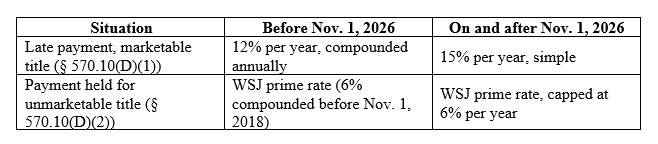
For owners, the higher simple rate means a bigger penalty in the first few years of a late payment. For operators, the cap on the unmarketable-title rate and the end of compounding put a ceiling on how fast long-held suspense can grow.
Change 2: Interest stops during certain good-faith delays
HB 1371 identifies situations in which statutory interest does not accrue, even though proceeds are being held:
• Probate required to cure title. No interest accrues where marketability remains uncured and a probate is required to cure it.
• Statutory liens. No interest accrues on proceeds held in suspense because statutory liens have been filed.
• Owner-requested holds. No interest accrues when proceeds are held at the owner's written request.
• Returned or uncashed payments. No interest accrues when a payment is returned to the payor as undeliverable, a check is never cashed, or an electronic payment is rejected.
These protections are not automatic. Commentators reviewing the bill note that the operator must keep appropriate records and show reasonable diligence to rely on them. An operator that cannot document why proceeds were suspended, and what it did to resolve the problem, should expect the non-accrual argument to be contested.
Change 3: The new Mineral Owner's Fund
HB 1371 creates the Mineral Owner's Fund, an escrow account administered by the Oklahoma State Treasurer for proceeds owed to unknown or unlocatable owners. Once proceeds have gone unpaid for 36 months, the payor may remit them, with accrued statutory interest, to the Fund. Remittance discharges the payor from further liability for those proceeds and the interest on them.
The Fund is expressly an alternative to interpleader, so operators can clear long-term suspense without a lawsuit. Owners keep their money: they can claim it from the State Treasurer with proof of identity and ownership. The Fund is modeled on the state's unclaimed property system and will be searchable online and published twice a year in newspapers statewide.
The bill also coordinates the PRSA with Oklahoma's Unclaimed Property Act. Mineral proceeds are not presumed abandoned until 36 months after they become due, unless they were remitted to the Fund earlier.
What this means in practice
For mineral and royalty owners. A late payment now earns a higher rate, but owners lose interest during the delays the bill names. The probate exception matters most for families. When a mineral owner dies without a completed probate, the operator will typically suspend the heirs' share until title is cured. Under the amended statute, that suspended money may sit without earning interest for as long as the probate remains open. Heirs who move quickly to open and close a probate, or who plan ahead so one is not needed, protect the value of those proceeds.
For heirs who don't know they own minerals. Oklahoma title chains often run back generations, and many heirs are unaware of their interests. After November 1, unpaid proceeds that reach 36 months may be moved to the Mineral Owner's Fund rather than staying with the operator. Checking the Fund, and the state's unclaimed property database, will become a routine step in locating family mineral income.
For operators and first purchasers. The interest regime is easier to model, and the Fund offers a clean exit from aged suspense. But the non-accrual rules reward documentation. Suspense codes, title requirements, curative correspondence, and owner contact attempts should be recorded well enough to prove why money was held and that the delay was handled diligently.
For pending and older claims. The amendments take effect November 1, 2026. How the new rules apply to interest that accrued under the prior statute, and to suits already on file, is likely to be litigated. Anyone with a pending PRSA claim or significant historical suspense should get specific advice rather than assume the new rules control.
Steps to take before November 1
1. Owners: Review recent check stubs for suspended interests, and confirm the operator has your current mailing address and payment information.
2. Heirs: If a mineral owner in your family has died, start the probate or other curative work now rather than waiting for the operator to ask.
3. Owners with old interests: Search the State Treasurer's unclaimed property records, and the Mineral Owner's Fund once it is live.
4. Operators: Update interest calculations for the 15% simple and capped-prime rates, and align suspense coding with the new non-accrual categories.
How CharneyBrown can help
CharneyBrown's practice sits where the PRSA does most of its work: mineral title examination, division order title opinions, division order practice, and the estate planning and probate that so often stand between heirs and their royalties. We help owners and families cure title and release suspended proceeds, and we help operators identify title requirements and build the records the new statute rewards. To discuss how HB 1371 affects your interests, contact our office.
This post is for general information only and is not legal advice. Reading it does not create an attorney-client relationship. Consult counsel about your specific situation.